




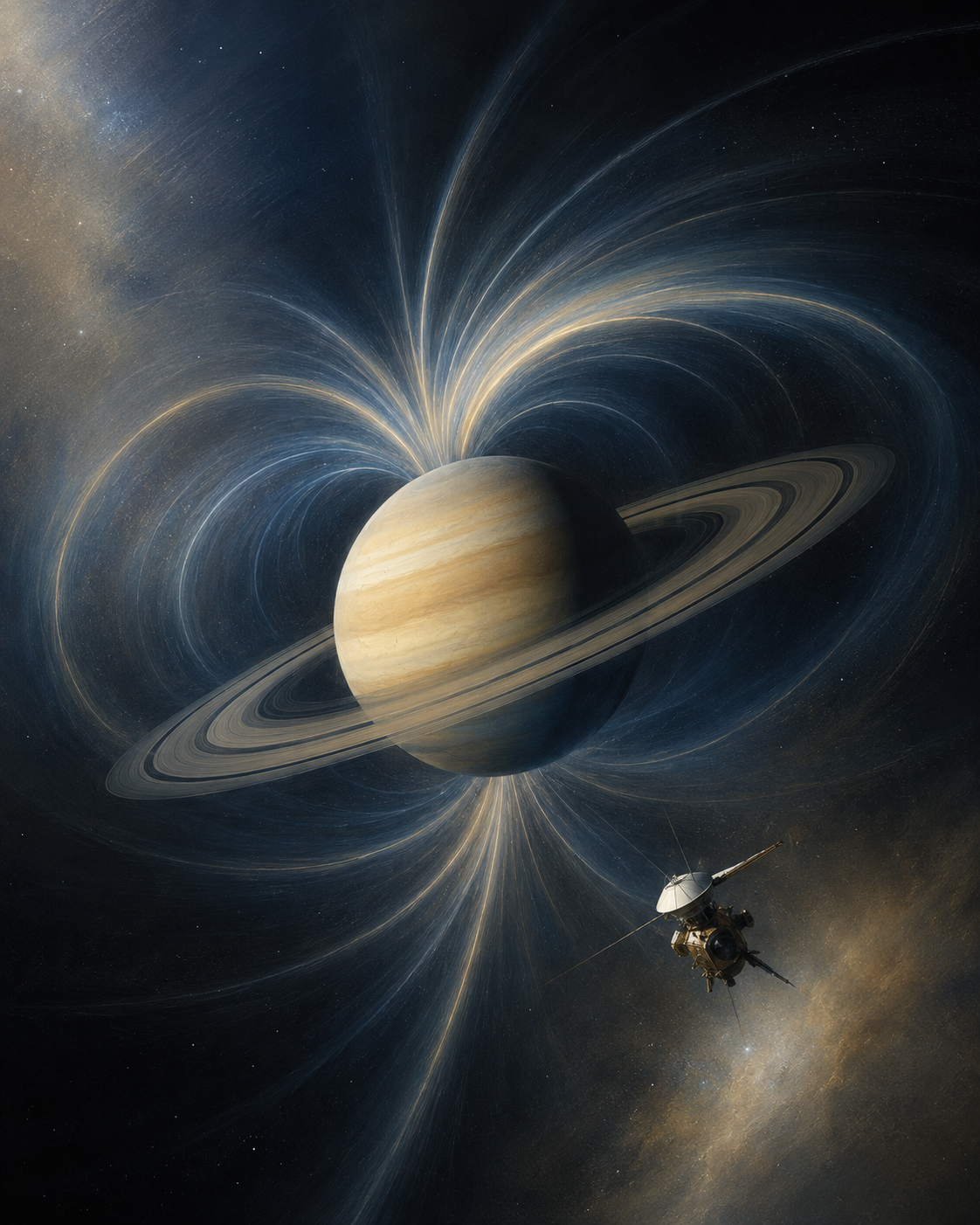
Saturn’s magnetic field has long posed a fascinating puzzle for astrophysicists, defying standard dynamo theories due to its almost perfect alignment with the planet’s rotational axis. A fresh analysis of archival NASA Cassini mission data has now revealed an unexpected twist, forcing scientists to rethink core planetary physics and how gas giant magnetospheres truly operate.
Saturn, the solar system’s second-largest planet, has long captivated astronomers with its majestic rings and complex atmospheric dynamics. However, far beyond its visible cloud tops lies a dynamic magnetic environment that operates under far stranger physical laws than previously assumed. By re-evaluating archival data collected during the joint NASA, European Space Agency (ESA), and Italian Space Agency (ASI) Cassini-Huygens mission, astrophysicists have discovered a dramatic structural anomaly within Saturn’s giant protective magnetic bubble (magnetosphere). Published in Nature Communications, this finding fundamentally changes how space scientists model gas giants and rapidly rotating exoplanets across the cosmos.
The Mystery of the Magnetospheric Cusp Displacement
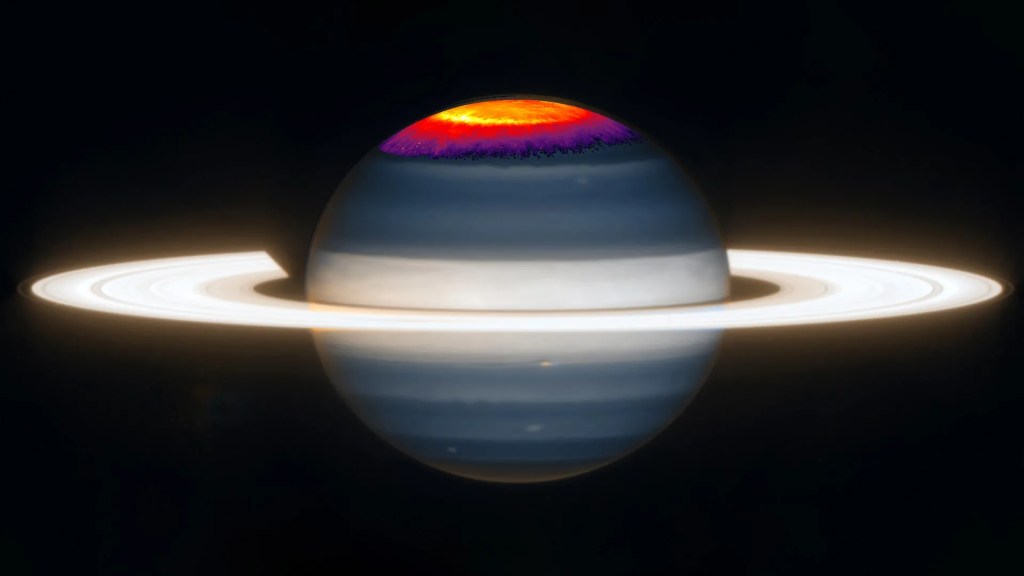
In planetary science, a magnetosphere acts as a cosmic shield, deflecting harmful high-energy particles streaming from the solar wind. Near a planet’s magnetic poles, however, field lines bend inward to form funnel-shaped openings known as magnetospheric cusps. These cusps serve as primary gateways, allowing energetic solar particles to penetrate directly into the upper atmosphere.
On Earth, magnetospheric cusps are stably aligned toward the Sun around local noon (12:00 local time), where solar wind dynamic pressure hits hardest. Scientists long assumed giant gas planets would mirror this solar-dominated configuration. However, new high-resolution magnetic map reconstructions from Cassini tell a completely different story.
Saturn’s primary magnetospheric cusp is dramatically dragged away from the subsolar point toward the afternoon sector—typically settling between 13:00 and 15:00 local time, and extending as far as 20:00 toward dusk. This severe asymmetric shift demonstrates that Saturn’s magnetic shield is not dictated by external solar forces, but rather controlled by an internal planetary engine.
Enceladus and Ultra-Fast Rotation: A Dual Powerhouse
To understand why Saturn’s magnetic shield twists so severely, researchers analyzed two interacting physical phenomena unique to the gas giant:
- Centrifugal Forces from Rapid Rotation: Despite its massive girth, Saturn completes a full planetary rotation in just 10.7 hours. This ultra-fast spin generates colossal centrifugal forces that stretch and deform the surrounding space environment.
- Cryovolcanic Mass Injection from Enceladus: Saturn’s icy moon Enceladus continuously spews giant plumes of water vapor and organic material into orbit from active cryovolcanoes at its south pole. Once exposed to solar radiation, this neutral gas becomes ionized, creating a dense, donut-shaped disk of heavy water-group plasma encircling the planet.
As Saturn spins at breakneck speed, its powerful magnetic field drags this massive cloud of Enceladus-derived plasma along with it. The resulting centrifugal stress pushes the spinning plasma disk outward, generating powerful internal current systems. These internal currents overpower incoming solar wind pressure, physically dragging the polar cusp funnels far toward the planet’s afternoon and dusk sectors.
Rewriting Models for Auroras and Exoplanetary Weather
This unexpected magnetic twist carries profound implications for high-energy astrophysics, particularly regarding particle acceleration and planetary aurora displays:
- Relocated Magnetic Reconnection: Magnetic reconnection—the process where oppositely directed field lines break and explosively reconnect—accelerates charged particles to high kiloelectronvolt energy scales. On Saturn, this high-energy reconnection does not occur at local noon, but is displaced into the afternoon sector.
- Shifted Auroral Coordinates: Because incoming particles follow these shifted magnetic field lines, upper atmospheric excitation and bright polar light displays occur at unexpectedly skewed coordinates rather than symmetric polar ovals.
- Implications for Deep Space Exoplanets: Astronomers can now apply these insights to distant gas giants. Fast-spinning exoplanets orbiting distant stars likely possess internally driven magnetospheres dominated by active icy moons and rapid rotation rather than stellar winds.
For further scientific details and technical data breakdowns regarding this discovery, visit the official ScienceDaily Cassini Report.