




How Artificial Intelligence and Computer Vision Are Revolutionizing International Art Theft Investigations and Heritage Preservation
Art crime has historically operated as a high-value, low-risk global enterprise, yielding billions of dollars annually for organized crime syndicates, illicit traders, and black-market facilitators. For decades, international law enforcement agencies—including Interpol, Europol, and specialized national art squads—have fought an uphill battle against sophisticated networks capable of smuggling, altering, and laundering stolen cultural artifacts. Traditional investigative methodology relied heavily on manual labor, expert eyes, physical archives, and textual keyword searches across fragmentally digitized databases. However, the rapidly expanding digital landscape and the shift of the art market toward online auctions and e-commerce platforms have dramatically outpaced conventional policing capabilities.
To counter this evolving criminal ecosystem, law enforcement agencies are turning to cutting-edge artificial intelligence, deep learning, and advanced computer vision technologies. Leading this technological renaissance is Italy’s Carabinieri Command for the Protection of Cultural Heritage (Comando Carabinieri Tutela Patrimonio Culturale), a specialized police unit that has developed and deployed groundbreaking algorithmic tools to monitor global art trade, analyze visual signatures, and recover long-lost cultural treasures. By automating the visual recognition process and searching for subtle patterns beyond human perception, artificial intelligence is proving to be a game-changing force multiplier in global heritage preservation.
The Scale and Complexity of the Global Illicit Art Trade
To understand the transformative impact of artificial intelligence in art recovery, one must first examine the sheer scale and complexity of global art trafficking. Cultural property crime includes illegal excavation, theft from religious institutions and museums, illicit importation and exportation, and the forging of provenance documentation.
The economic magnitude of this illicit market is vast, ranking alongside arms trafficking and narcotics smuggling in terms of profitability and transnational reach. International bodies such as UNESCO and the International Council of Museums (ICOM) have long documented how looted artifacts fuel criminal networks and exploit regulatory loopholes across jurisdictions in Europe, North America, and emerging markets worldwide.
| Aspect | Traditional Art Crime Investigation | AI-Powered Digital Investigation |
| Search Speed | Manual keyword querying across paper/digital text records | Automated multi-million image cross-matching in seconds |
| Visual Analysis | Human inspection limited by fatigue and subjective memory | Deep spatial vector mapping and micro-pattern matching |
| Altered Artwork Detection | Extremely difficult without prior specific suspicion | Detects isolated segments, cropped canvases, and repainted details |
| Web Coverage | Periodic physical visits and selective online browsing | Continuous 24/7 autonomous scraping of clear and dark web |
| Data Handling | Fragmented text descriptions and static photo registries | Dynamic multi-dimensional database indexing with visual embeddings |
The Limits of Heritage Protection Before Artificial Intelligence
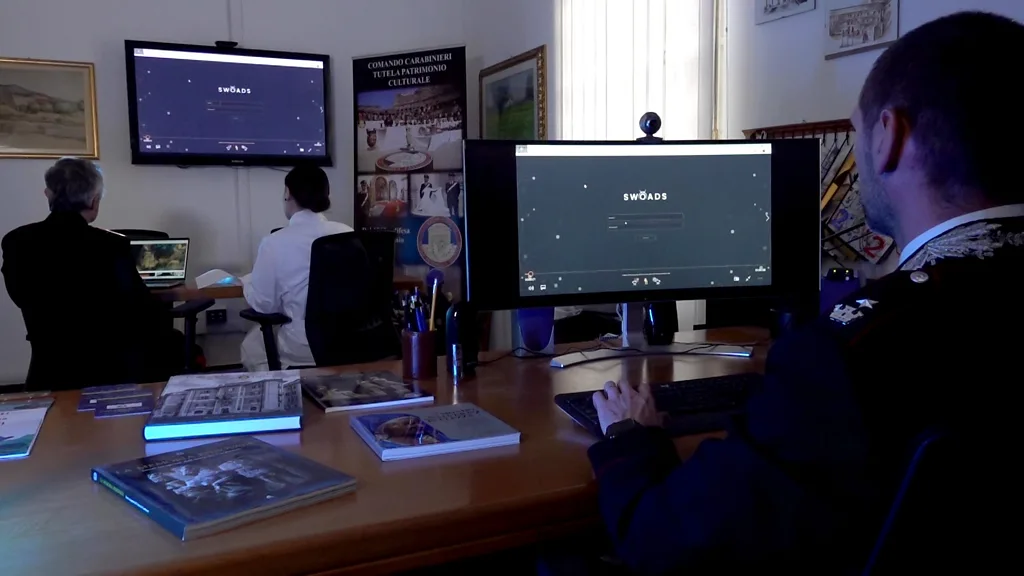
Historically, tracking stolen cultural heritage presented massive operational bottlenecks. In Italy, where law enforcement maintains the world’s largest repository of stolen cultural goods—the Leonardo database, containing over one million entries—investigators faced severe constraints:
- Incomplete or Low-Quality Archives: Many records were established decades ago, relying on graining black-and-white photographs taken under poor lighting conditions, far-away angles, or on private walls before theft occurred.
- Textual Search Vulnerabilities: Searching for a stolen painting required query strings based on subjective human interpretations, such as “oil painting of woman holding scroll” or “17th-century bronze statuette”. If a thief modified the artwork, these text queries became entirely useless.
- Physical Alterations by Criminals: Art traffickers routinely modify stolen works to evade detection. Large religious altarpieces are frequently cut into smaller panels and sold individually, while identifiable attributes—such as halos, saintly symbols, or background landscapes—are repainted to pass off sacred art as secular portraits.
- Volume of E-Commerce Transactions: With thousands of auction houses, social media storefronts, and private marketplaces listing items daily across Europe, North America, and Asia, human officers could only review a fraction of public sales.
Swoads: Italy’s Algorithmic Sentinel for Cultural Heritage
To solve these systemic challenges, Lt Col Salvatore Rapicavoli, an IT engineer and officer within the Carabinieri specialized squad, spearheaded the creation of the Stolen Works of Art Detection System (Swoads). Launched conceptually in 2020 and fully deployed into active field operations in November 2023, Swoads represents a paradigm shift in visual intelligence.
How Computer Vision Overcomes Criminal Concealment
Unlike traditional query systems that search for descriptive text, Swoads utilizes convolutional neural networks (CNNs) and deep spatial embedding algorithms. The software decomposes images into high-dimensional vector representations that map core structural attributes:
- Color Distribution Signatures: Analyzing underlying chromatic relationships, brushstroke densities, and tonal gradients.
- Silhouette and Geometry Extraction: Identifying structural forms, outline ratios, and compositional geometry that remain intact even if the surface paint is altered.
- Segment and Fragment Reconciliation: Matching isolated slices of chopped canvases back to the original full-scale masterwork recorded in historical archives.
Because the software evaluates structural visual math rather than semantic meaning, it does not care whether a subject appears to be a religious figure or a secular portrait. The system simply identifies whether visual component $A$ matches stored database signature $B$.
Case Studies: High-Profile Recoveries Driven by AI
The operational efficacy of Swoads and computer vision software has been demonstrated across numerous high-profile cases across Europe, illustrating how technological precision translates directly into law enforcement victories.
1. The Mystery of Saint Agnese: From Altarpiece to Secular Portrait
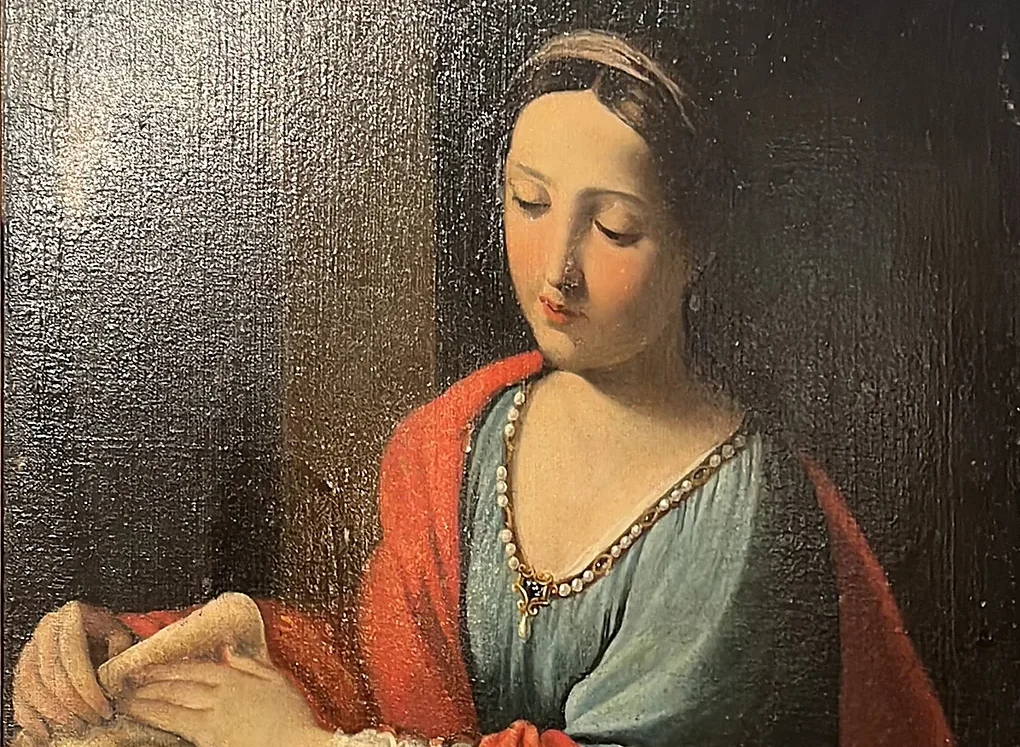
During the annual Parma Antiquity Fair in October 2024, undercover Carabinieri officers conducted routine documentation by photographing exhibited artworks. A snapshot of a painting featuring a fair-skinned young woman wearing aquamarine and red, holding a half-unravelled parchment scroll, was fed into the internal police system.
Within hours, Swoads flagged a high-probability match against a 17th-century, one-meter-tall canvas representing Saint Agnese, which had been stolen on the night of August 11, 2004, from the Church of Virgo Potens in Sulmona, near Naples—more than 500 kilometers away.
Upon physical seizure and expert forensic examination, art restoration specialists confirmed that criminals had heavily altered the painting to disguise its origins:
- The original lamb held by the saint had been repainted as a parchment scroll.
- The sacred halo and palm branch had been completely painted over to erase religious context.
A traditional keyword search for “woman with a scroll” would never have surfaced a database entry for a “saint with a lamb”. However, Swoads detected matching spatial contours, color composition, and canvas geometry, allowing officers to solve a 20-year-old cold case.
2. The Recovery of Palizzi’s Riposo Della Pastorella
In 2026, the Swoads system achieved another milestone by analyzing online auction listings in Turin. The algorithm flagged an item cataloged on a commercial auction website as Riposo Della Pastorella (The Rest of the Shepherdess) by Italian artist Filippo Palizzi.
The masterpiece had been stolen in June 1972 during a violent gallery robbery that forced the museum to close its doors for over three decades. Lost in black-market distribution channels for over 50 years, the painting was identified autonomously by Swoads during routine automated internet scraping, leading to its immediate recovery by Italian authorities.
Quantifying the Impact: Recovery Metrics and Financial Valuation
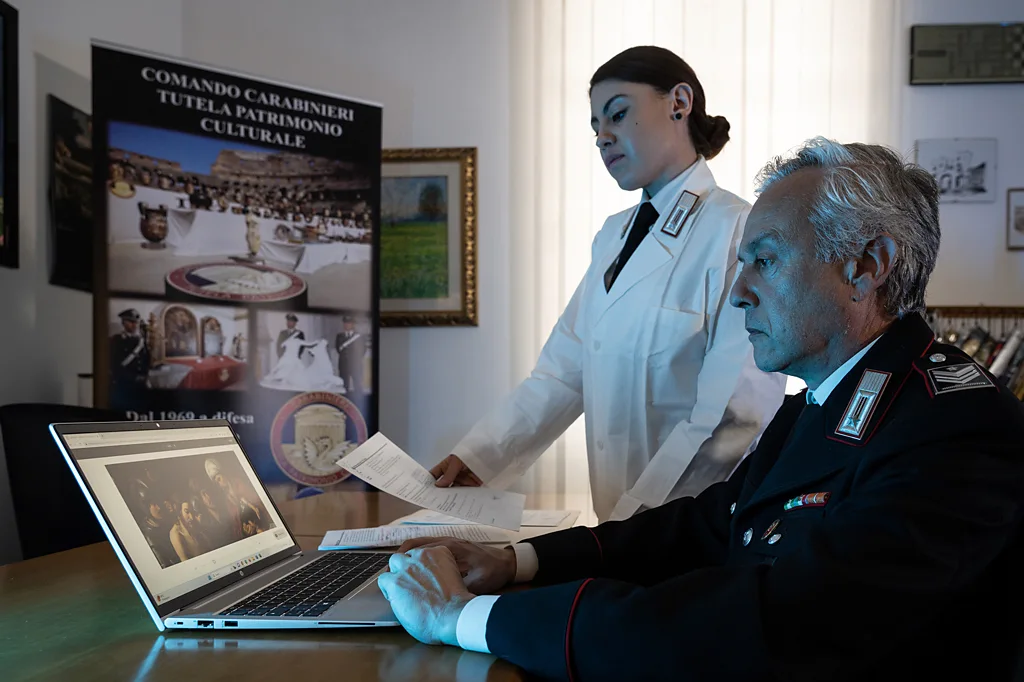
Since the operational deployment of Swoads in late 2023, the Italian Carabinieri unit has achieved unprecedented recovery statistics, setting a new benchmark for global heritage policing.
| Category of Recovered Cultural Artifacts | Number of Recovered Units | Estimated Total Economic Value |
| Large Masterpieces (Oil Paintings, Altarpieces, Sculptures) | 300+ | €150M+ ($167M+) |
| Smaller Artifacts (Coins, Medals, Manuscripts, Stamps, Religious Items) | 165,000+ | €53M+ ($59M+) |
| Total Cumulative Recoveries | 165,300+ | €203M+ ($226M+) |
These financial and quantitative figures reflect not only the recovery of tangible economic wealth but also the restoration of irreplaceable cultural identity and historical legacy to public institutions and community collections across Europe.
The Wider Technological Ecosystem: Authentication and Provenance Verification
AI application in the art world extends beyond police detection systems. Organizations in the private sector and academic institutions are utilizing artificial intelligence for provenance verification, forgery detection, and condition report automation.
For instance, companies like Art Recognition utilize deep learning models trained on verified historical masterworks to evaluate brushstroke texture, microscopic cracks (craquelure), and pigment layering. These private algorithms help determine whether an artwork offered on the international market is an authentic masterpiece, a contemporary workshop replica, or a modern forgery.
When paired with police databases like Swoads, AI authentication creates a dual security barrier:
- Police AI (e.g., Swoads): Solves the question of provenance and theft (“Has this specific object been reported stolen?”).
- Private Authentication AI: Solves the question of authenticity (“Was this object created by the claimed master artist?”).
Technical Challenges and Algorithmic Limitations
While machine learning has transformed art recovery, law enforcement professionals and computer scientists emphasize that artificial intelligence remains a supportive instrument rather than an independent solution.
The Problem of Unreported Thefts
AI models can only match images against existing digital databases. If an archaeological artifact is illegally excavated from an unrecorded Etruscan or Roman tomb and smuggled directly out of the country, no baseline record exists within law enforcement databases. Machine learning cannot flag an item that has never been documented.
Data Standardizations Across International Borders
While Italy maintains a centralized database with over one million entries, many nations lack fully digitized cultural heritage registries. Differences in image resolution, metadata standards, and legal frameworks between European Union member states and international partners create hurdles when syncing cross-border intelligence networks.
Human Intervention and Legal Admissibility
An algorithmic match does not constitute immediate legal proof of theft or guilt. Artificial intelligence acts as an automated investigative lead. Physical seizure, forensic analysis, chemical paint testing, provenance auditing, and court proceedings still require skilled art historians, forensic scientists, prosecutors, and international judicial cooperation.
Future Outlook: Autonomous Web Crawling and Dark Web Monitoring
As illicit art trading increasingly migrates toward encrypted messaging channels, private social media groups, and dark web marketplaces, the next frontier for art detection technology lies in autonomous multimodal crawling.
Future iterations of software like Swoads are being designed to combine computer vision with natural language processing (NLP) to scan unstructured web data, cross-reference seller aliases, trace cryptocurrency transactions tied to high-value cultural goods, and map global smuggling routes in real-time. European law enforcement agencies are actively working to integrate these smart systems into international networks such as Europol’s focal points on environmental and cultural crime.
Through the fusion of engineering, art history, and international law enforcement, artificial intelligence is closing the net on global art crime, ensuring that humanity’s shared cultural heritage is protected for generations to come.