



Vast Milky Way Galaxy holds countless secrets waiting to be discovered. In this blog post, you will commence on a journey through the stars to uncover the wonders and mysteries that lie within our celestial home. From black holes to hidden planets, you will learn about the enigmatic forces shaping our galaxy and the secrets that you may have never imagined. Join us as we explore into the unknown and unravel the mysteries of the Milky Way.
Key Takeaways:
- Galactic Structures: The Milky Way Galaxy is filled with various structures such as stars, planets, gas clouds, and more, each revealing different secrets and mysteries.
- Dark Matter: A significant amount of dark matter is believed to exist in the Milky Way, impacting its gravitational dynamics and potentially hiding unknown secrets.
- Black Holes: The presence of black holes within the Milky Way raises questions about their role, behavior, and potential impact on surrounding objects.
- Stellar Evolution: Studying stars within the galaxy helps uncover secrets about their life cycles, from formation to eventual demise, shedding light on the universe’s evolution.
- Exoplanets and Life: Discovering exoplanets within the Milky Way presents the possibility of finding habitable planets and potential life, uncovering the secrets of extraterrestrial existence.
The Mysterious Structure of the Milky Way
Before delving into the secrets that the Milky Way holds, it’s important to understand the mysterious structure of our galaxy. The Milky Way is a barred spiral galaxy, with a central bulge surrounded by spiral arms extending outwards. Studying this structure can reveal a wealth of information about the history and evolution of our galaxy.
Unveiling the Galactic Center
An exciting area of study in galactic astronomy is uncovering the secrets of the Galactic Center. At the very heart of the Milky Way lies a supermassive black hole called Sagittarius A*. Scientists are studying the behavior of stars and gas clouds around this black hole to understand its impact on the galaxy’s structure and evolution. The Galactic Center is a hub of activity, with powerful forces at play that shape the dynamics of the entire Milky Way.
The Spiral Arms Enigma
Centered around the **Spiral Arms** of the Milky Way lies a fascinating mystery known as the Spiral Arms Enigma. These arms consist of dust, gas, and young stars that create beautiful patterns across the galaxy. Scientists are still trying to understand the mechanisms that maintain the **structure** and dynamics of these arms. **It** is believed that density waves, gravitational forces, and interactions with neighboring galaxies play crucial roles in shaping the Spiral Arms.
Dark Matter and Dark Energy

The Invisible Forces Shaping the Galaxy
Any exploration of the mysteries hidden within the vast Milky Way galaxy inevitably leads you to the perplexing concepts of dark matter and dark energy. These invisible forces play a crucial role in shaping the structure and evolution of our galaxy, yet they remain elusive and enigmatic.
Uncovering the Mysteries of Dark Matter
Matter that does not emit, absorb, or reflect light, dark matter comprises roughly 27% of the universe, compared to the mere 5% that is made up of ordinary matter. To understand the nature of dark matter, scientists rely on gravitational effects it exerts on visible matter. Despite extensive research, the true identity of dark matter remains a profound cosmic puzzle.
To examine deeper into the mysteries of dark matter, scientists use a variety of sophisticated techniques, including gravitational lensing, simulations, and particle physics experiments. These methods offer valuable insights into the properties and distribution of dark matter in the Milky Way and beyond, bringing us closer to unraveling its secrets.
The Role of Dark Energy in Galactic Evolution
With the discovery of dark energy in the late 1990s, astronomers were introduced to yet another enigmatic phenomenon that influences the expansion of the universe. Dark energy, constituting approximately 68% of the universe, exerts a repulsive force that accelerates the universe’s expansion. This mysterious energy not only shapes the fate of the cosmos but also plays a significant role in the evolution of galaxies, including our own Milky Way.
On Understanding Dark Energy in Galactic Evolution
Plus, dark energy’s repulsive nature poses a profound challenge to our current understanding of fundamental physics. Its presence in the universe suggests the existence of a mysterious form of energy that defies conventional explanations. By studying its effects on galactic structures and cosmic evolution, scientists strive to unlock the secrets of dark energy and its impact on the Milky Way galaxy.
The Star-Forming Regions
Despite the vastness of the Milky Way galaxy, it is filled with fascinating phenomena that shape the cosmos as we know it. According to Milky Way galaxy: Facts about our cosmic neighborhood, the star-forming regions within our galaxy are some of the most active and intriguing areas. These regions serve as the cosmic nurseries where new stars are born, shaping the future of our galaxy.
Nebulae: The Cosmic Cradles of New Stars
To witness the birth of stars, you must look towards nebulae, vast clouds of dust and gas scattered throughout the galaxy. Within these cosmic cradles, gravity slowly pulls the material together, forming dense cores where new stars begin to ignite. The process is a mesmerizing dance of heat and pressure, as the newborn stars start shining brightly within the nebula.
The Life Cycle of Stars
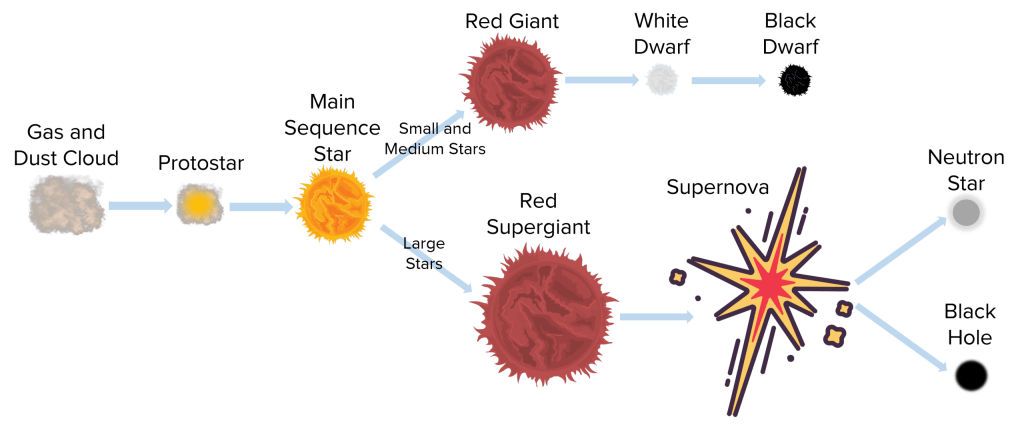
To understand the evolution of stars, you must grasp their life cycle. Stars are born within the nebulae, where they spend millions to billions of years fusing hydrogen into helium in their cores, radiating light and heat. As they exhaust their fuel, stars evolve through various stages until they meet their inevitable fate.
Another crucial aspect of the star’s life cycle is their eventual demise. When a star reaches the end of its nuclear fuel, it undergoes a spectacular event known as a supernova, marking the explosive end of a stellar life.
Supernovae: The Explosive End of a Star’s Life
Cosmic explosions known as supernovae are some of the most powerful events in the universe. During a supernova, a dying star undergoes a catastrophic collapse, releasing an immense amount of energy in a brilliant explosion. This explosive event disperses heavy elements into space, enriching the cosmos with materials crucial for the formation of new stars and planets.
Black Holes and Gravitational Waves
Unlike other features in the Milky Way Galaxy, Webb telescope discovers strange features in Milky Way at its heart, black holes remain some of the most mysterious and enigmatic objects. These cosmic phenomena are the remnants of massive stars that have collapsed under their gravity to an infinitesimally small point, creating a gravitational pull so intense that nothing, not even light, can escape their grasp. At the center of our galaxy lies a supermassive black hole, known as Sagittarius A*, which exerts a powerful influence on the surrounding stars and gases.
The Monster at the Galactic Center
Holes at the center of the Milky Way are unimaginably massive, with the one at the galactic center being millions of times more massive than our sun. Despite their immense size, these black holes are difficult to detect directly due to their ability to swallow light, making them hidden from conventional telescopes.
Detecting Gravitational Waves from Merging Black Holes
Merging black holes produce ripples in the fabric of space-time known as gravitational waves, which were predicted by Albert Einstein’s theory of general relativity. In recent years, advancements in technology have allowed scientists to detect these elusive signals using instruments like the Laser Interferometer Gravitational-Wave Observatory (LIGO).
Another exciting development is the observatory’s ability to not only detect gravitational waves from black hole mergers but also from other cosmic events such as neutron star collisions. These observations provide crucial insights into the dynamics of the universe and help us unravel its most profound secrets.
The Implications of Gravitational Waves on Our Understanding of Space-Time
SpaceTime is not as static and unchanging as it may seem. Gravitational waves serve as messengers from the distant corners of the cosmos, carrying information about cataclysmic events that occurred billions of years ago. By studying these waves, scientists can examine deeper into the nature of space-time itself and gain a better understanding of the fundamental forces governing the universe.
Holes in space-time caused by massive objects like black holes lead to distortions that affect the motion of celestial bodies. Gravitational waves open up a new window into the cosmos, offering a fresh perspective on the dynamic and ever-evolving nature of the universe.
The Search for Extraterrestrial Life
The Possibility of Life in the Milky Way
Life in the Milky Way galaxy is a captivating topic that sparks the imagination of scientists and enthusiasts alike. The sheer size and diversity of our galaxy suggest that the conditions for life may exist beyond our planet. With billions of stars and planets in the Milky Way, the possibility of finding extraterrestrial life seems increasingly promising. While the search for alien life forms is a daunting task, the potential discoveries could revolutionize our understanding of the universe.
Exoplanets: The Hunt for Habitable Worlds
With advances in technology, scientists have begun to identify exoplanets that may have the right conditions to support life. These “habitable worlds” orbit within their star’s habitable zone, where liquid water could exist on their surfaces. The search for exoplanets is a crucial step in the quest to find extraterrestrial life, as these distant planets could hold the key to unlocking the mysteries of the universe.
Exoplanets are of great interest to researchers studying astrobiology, as they offer a glimpse into the potential diversity of life beyond Earth. By studying the atmospheres and compositions of exoplanets, scientists hope to identify signatures of life that could indicate the presence of alien organisms.
The Role of Astrobiology in the Search for Life
Habitable planets and the search for extraterrestrial life are central themes in the field of astrobiology. This interdisciplinary science combines biology, astronomy, geology, and chemistry to explore the potential for life in the universe. Astrobiologists study extreme environments on Earth to understand where life could exist beyond our planet and devise strategies for detecting alien life forms.
It is necessary to consider the implications of finding extraterrestrial life, as this discovery could have profound effects on our understanding of the cosmos and our place within it. The search for life in the Milky Way galaxy continues to drive scientific exploration and fuel our curiosity about the vast mysteries that lie hidden among the stars.
The Milky Way’s Place in the Universe

Keep exploring the mysteries of the Milky Way galaxy, for within its vast expanse lies a dark secret that continues to intrigue scientists and stargazers alike. To shed light on this clandestine enigma, The Milky Way’s dark secret holds clues to its hidden truths.
Galactic Neighborhood
Your journey through the Milky Way unveils a rich tapestry of celestial neighbors. These neighboring galaxies, such as the majestic Andromeda galaxy and the ethereal Triangulum galaxy, paint a picture of the vast cosmic community in which the Milky Way resides. Each galaxy contributes its unique beauty and character to the intricate dance of the cosmos.
The Cosmic Web: A Network of Galaxies
The cosmic web is a complex network of galaxies interconnected by invisible threads of dark matter and cosmic filaments. Within this expansive structure, galaxies are not isolated islands but rather interconnected nodes in a grand cosmic tapestry. This intricate web of galaxies shapes the large-scale structure of the universe, influencing the evolution and interactions of galactic communities.
The interconnected nature of the cosmic web reveals the interdependence of galaxies within the universe. It highlights how the Milky Way’s existence and evolution are intricately linked to the movements and dynamics of the galaxies surrounding it. As you navigate the cosmic web, you begin to grasp the intricate relationships that govern the universe at large.
The Evolution of the Universe and the Milky Way’s Role
Networked within the cosmic web, the Milky Way plays a pivotal role in the ever-evolving drama of the universe. From its humble origins to its current majestic spiral form, the Milky Way has been a witness to the grandeur of cosmic evolution. As galaxies interact and merge, stars are born and die, and the universe continues its eternal dance of creation and destruction.
Conclusion
Ultimately, as you peer into the vastness of the Milky Way galaxy, you can’t help but wonder about the mysteries and secrets it holds. From the countless stars and planets to the enigmatic dark matter and energy that pervade the cosmos, there is so much we have yet to uncover and understand about our celestial home. Each discovery and exploration only serves to deepen our awe and curiosity about the wonders of our universe.
So, as you gaze up at the night sky and contemplate the secrets hidden within the Milky Way galaxy, remember that the quest for knowledge and understanding is an endless journey. There is always something new and intriguing to learn about the universe we inhabit, inspiring us to keep exploring, questioning, and marveling at the beauty and complexity that surrounds us.
Q: What is the Milky Way galaxy?
A: The Milky Way galaxy is a spiral galaxy that contains our solar system. It is home to billions of stars, planets, and other celestial bodies.
Q: What secrets lie hidden in the Milky Way galaxy?
A: The Milky Way galaxy holds many mysteries, including the presence of dark matter, black holes, and potentially other forms of life beyond Earth.
Q: How big is the Milky Way galaxy?
A: The Milky Way galaxy is vast, spanning approximately 100,000 light-years in diameter and containing hundreds of billions of stars.
Q: Are there potentially habitable planets in the Milky Way galaxy?
A: Scientists have discovered numerous exoplanets within the Milky Way galaxy that are located within the habitable zone of their stars, making them potential candidates for hosting life.
Q: How do scientists study the Milky Way galaxy?
A: Scientists use a variety of tools and technologies, such as telescopes and space probes, to study the Milky Way galaxy. They analyze data to learn more about its structure, composition, and evolution.
